Summer Readiness for Controlled Environment Agriculture: Preventing Heat Stress Before It Reaches the Canopy
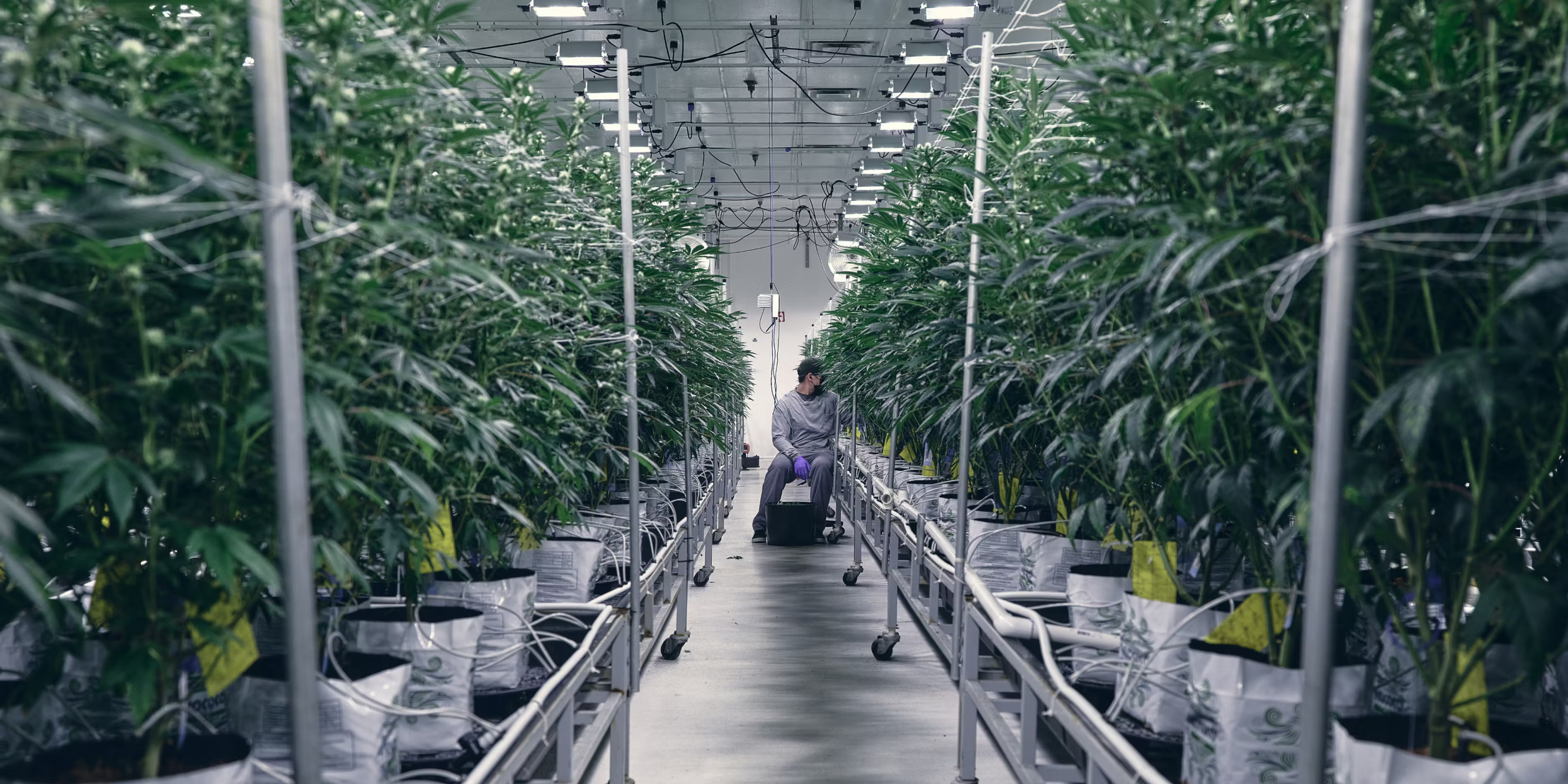
Summer is not forgiving to cannabis cultivation. Winter stress tends to be visible, with frozen lines, condensation, and stalled metabolism, but heat stress in a controlled environment often hides in the data long before it shows up in the canopy. By the time you see tip burn, bleaching, or foxtailing, the plant has already been operating in a compromised state for days.
Here are the critical areas every CEA operation should be evaluating before outdoor temperatures climb, and before your environmental control systems are put to the test.
Power and HVAC: The First Point of Failure
In summer, the pressure on your power infrastructure runs in the opposite direction from winter, but the stakes are identical. HVAC systems that were designed to heat are now running at maximum cooling capacity for extended periods. Grid demand peaks on hot days, increasing the risk of brownouts and voltage fluctuations that can compromise variable-speed drives, irrigation controllers, and monitoring equipment.
Critical questions to ask your team:
- What is our contingency if the grid experiences a brownout or rolling outage during peak cooling load?
- Are our chillers, condensers, and rooftop units rated for the highest ambient temperatures we may see this season? Have they been serviced, with coils cleaned and refrigerant levels verified?
- Do we have redundant cooling capacity, or does a single HVAC failure put the entire room at risk?
- Is our AROYA Gateway on a UPS so we maintain environmental visibility and data continuity during an outage?
Many facilities underestimate how hard their equipment works during a heat event. A chiller that performs adequately at 85°F outdoor ambient may struggle significantly at 100°F+, producing room temperatures that drift 4 to 6°F above setpoint before operators notice. By then, VPD has already shifted outside the target window.
Environmental Control: Managing VPD When Heat Pushes Back
VPD is the primary lever in crop steering, and summer is where VPD becomes hardest to control. As outdoor temperatures rise, infiltration of warm, dry air increases vapor pressure deficit faster than most dehumidification systems are designed to compensate for. The result: VPD spikes, stomata close, transpiration drops, and calcium uptake stalls.
Critical questions to ask your team:
- What is our upper VPD ceiling by stage, and do we have alerts configured in AROYA when we breach it?
- Are we monitoring the relationship between room temperature and RH in real time, or are we checking in periodically and reacting to visual cues?
- Is our humidification system sized to keep up with the latent load added by high-output lighting in a 90°F+ outdoor environment?
- Have we reviewed our climate station data from last summer to identify which rooms or time windows are most vulnerable to VPD excursions?
In flowering, where precision matters most, a VPD excursion above 1.5 kPa for even a few hours can trigger a measurable slowdown in transpiration. This is visible in AROYA's Water Content graphs. If your substrate isn't drying back at the rate your steering plan calls for, heat-related stomatal closure is often the first place to look.
Substrate and Root Zone: Where Heat Stress Starts
The substrate is the engine of the plant. In summer, the risk is not just ambient air temperature. It is root zone temperature. Many facilities cool their canopy effectively while the slabs near lighting fixtures, reflective surfaces, or poorly insulated walls are quietly heating to 78°F, 80°F, or higher.
Root zone temperatures above 75°F accelerate microbial activity in the substrate, reduce dissolved oxygen availability, and can cause root death in severe cases. They also alter EC and pH dynamics at the root surface in ways that drift outside your steering parameters without triggering obvious visual signals.
Critical questions to ask your team:
- Are we monitoring substrate temperature directly, or are we assuming it tracks ambient air temperature?
- Have we set AROYA alerts for substrate temperature exceedances above 75°F?
- Is our source water tempered before delivery? Water pulled from storage tanks in a warm mechanical room can arrive at the root zone 5 to 10°F above the target temperature, delivering a metabolic spike with every irrigation event.
- Are our fertilizer concentrates stored in a temperature-controlled environment? High ambient temperatures can shift the solubility of certain compounds, causing precipitation and EC drift in your Batch Tank exactly when precision matters most.
If you are running Drip and Drain, pay particular attention to drain EC during heat events. Increased transpiration without a corresponding increase in irrigation frequency leads to salt accumulation in the substrate. Monitoring your drain-to-feed EC ratio in AROYA is one of the clearest early signals that your steering plan needs a heat-season adjustment.
Irrigation: Heat Means Your Plan Needs to Adapt
A crop steering plan calibrated for spring conditions will underperform in summer. Increased transpiration demand means plants can move through field capacity and into dry-back faster than your scheduled irrigation events allow. Conversely, if your room temperature spikes and stomata close, your substrate may stay wetter than intended, creating the conditions for root zone hypoxia and disease pressure.
Critical questions to ask your team:
- Are we adjusting shot size and frequency as ambient temperature climbs, or are we running the same schedule we used in April?
- Are we watching post-shot Water Content response to detect when the substrate is not absorbing normally, which can signal heat-related root damage or emitter clogging from precipitated nutrients?
- Have we verified that all emitters are delivering at the expected flow rate? High temperatures accelerate biofilm growth in irrigation lines and can cause partial clogging that leads to uneven distribution across a bench or room.
- If using AutomAIt, have we confirmed that our guardrails are set appropriately for summer canopy demand?
Realistically, not every operation can act on all of these equally. Checking emitters and swapping feed lines after a few cycles is routine for most teams. Adjusting environmental setpoints as the season turns is harder, and for many facilities it is constrained more by equipment capability than by attention. The point is not that every box gets checked. It is that someone is watching the right signals and pushing the system as far as the hardware allows.
The Water Content curve is the most direct window into how the plant is responding to heat. A flat or slowly declining curve in the middle of the light period, when plants should be transpiring actively, is one of the most reliable indicators of heat stress before any visual symptoms appear.
Sensors and Data Integrity: Protecting Your Decision Layer
Heat events are exactly when accurate data matters most, and they are also when sensors are most likely to produce misleading readings if they are improperly positioned or maintained.
Critical questions to ask your team:
- Are our TEROS substrate sensors positioned away from container edges where temperatures are higher, and away from direct airflow from cooling vents where readings may be artificially suppressed?
- Are our climate station sensors placed at canopy height and representative of actual plant conditions, not skewed by proximity to an air handler, light fixture, or exterior wall?
- Have we cross-checked sensor readings against a calibrated reference thermometer and hygrometer since last season?
- Are all sensor connection points and cables secure and protected? Thermal cycling, the repeated expansion and contraction of materials as temperatures rise and fall daily, can loosen connections and introduce data gaps at critical moments.
A 2°F error in your temperature sensor translates directly into an error in your calculated VPD, and in a flowering room that can nudge your steering decisions in the wrong direction. The goal here is trustworthy data, not perfect numbers. A facility can run a 10°F day-to-night swing or sit a few points outside the optimal VPD window and still produce clean, sellable product that keeps the operation healthy. The risk is steering off readings you cannot trust, not steering off a room that isn't textbook. Get the data right first, then make reasonable calls within what your equipment can actually hold. Data quality is the foundation every other decision rests on.
Labor: Heat Events Demand More, Not Less
Automation reduces the daily labor overhead of cultivation, but it does not eliminate the need for physical presence and verification. Heat events can unfold faster than remote response allows, and the combination of external heat, internal lighting load, and potential HVAC degradation can push a room from nominal to critical within hours.
Critical questions to ask your team:
- Do staff have a clear protocol for responding to a heat alert? Who is notified, in what order, and what actions are taken first?
- Are remote monitoring alerts configured with appropriate thresholds so that temperature and VPD excursions trigger notification before damage occurs, not after?
- Are we accounting for staff safety during heat events? Grow rooms under thermal stress are dangerous work environments. Ensure hydration, rotation, and rest protocols are in place.
- Who has the authority and knowledge to make emergency crop decisions, such as adjusting irrigation, modifying lights, or initiating manual cooling, when the primary cultivator is unavailable?
Insurance and Documentation: Know the Process Before You Need It
A crop loss event in summer is not the time to be searching for insurance contacts or reconstructing environmental data. Every piece of documentation that supports a claim should be organized, accessible, and understood by at least two people on your team.
Critical questions to ask your team:
- Who is responsible for documenting and reporting crop or equipment damage?
- Is our AROYA data being used as part of our risk documentation? Environmental logs showing the timeline of a heat event are often critical to a successful claim.
- Who has immediate access to insurance contacts and policy documentation?
- How quickly can we generate a historical data export from AROYA if required by an adjuster?
Preparedness Is a System
Summer resilience, like winter resilience, is not a single checklist item or a single piece of equipment. It is the intersection of power reliability, environmental control precision, substrate health, irrigation strategy, data integrity, and operational readiness.
The cultivation teams that navigate summer heat events with minimal crop impact are not the ones with the newest equipment. They are the ones who have reviewed their data from the previous season, identified their vulnerabilities, and built response protocols before the first heat advisory is issued.
As outdoor temperatures become more extreme and margin pressure in the industry remains intense, summer readiness is not optional. It is a core component of professional cultivation strategy.
"Dialing it in and just being able to see every aspect of the rooms and the plants at the same time, it's helped immensely." Orion Santana, Vertical